Runaway to Record Breaker: Zhao Jiaju on Willpower, Pain, and the Tor des Géants
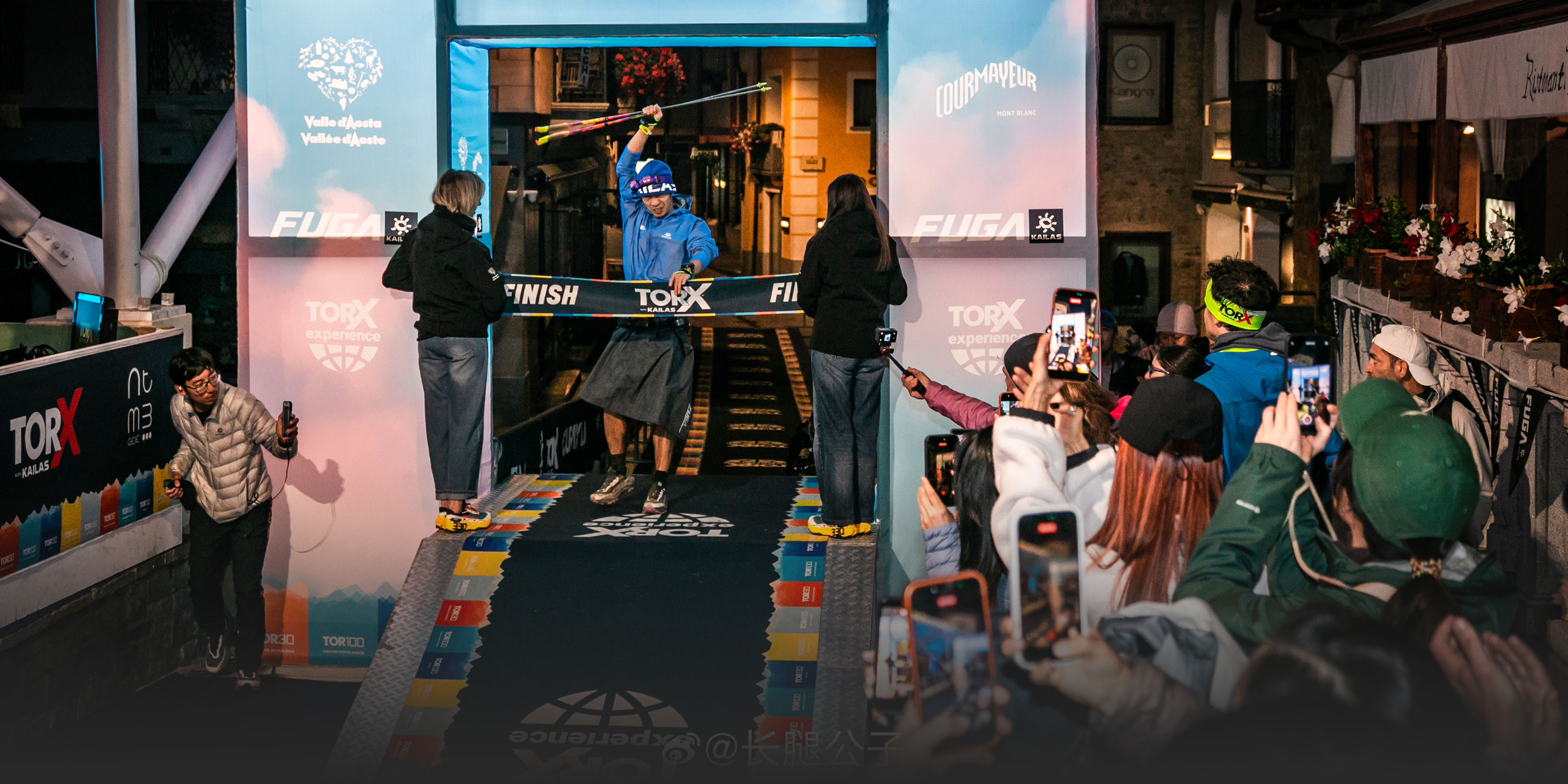
Editor’s note: In the early hours of Sept. 16, Zhao Jiaju crossed the finish line to win the 2026 Tor des Géants, an endurance trail race covering 336.1 kilometers through the Italian Alps, in a record 65 hours, 55 minutes, and 22 seconds. Here, the 31-year-old talks with The Paper about the experience and shares how it feels to be the race’s first Asian champion.
The Paper: How’s your body holding up?
Zhao: It’s dehydrated. During the race, the sun just hammered down on us. It was so dry that my lips split open. My scalp was scorched red — in a few days the skin will start peeling off in sheets.
But still, I’m recovering, getting better day by day. My feet still hurt, but not as badly as they did. My upper body is fine, actually. It’s the legs that took the real beating.
Sometimes when I touch my body, it feels unreal. That feeling was far stronger yesterday; it’s less noticeable today. Even when I pinch myself, it doesn’t hurt as much.
The Paper: You wore the No. 1 bib, and at the start said you were going to win in record time. Were you really that confident?
Zhao: I didn’t think my physical capacity was strong enough, but I knew my willpower was. After all these years on the trail, it’s been honed to a fine degree. I knew the Tor des Géants would come down to sheer willpower, to who could hold on longest when everything inside you is screaming to stop. I knew that’s where I held an advantage.
Before the race, I truly meant that bold claim about breaking the record. I believed I could, and that’s the power of belief.
I started running 100-kilometer ultramarathons in 2017. Since then, I’ve been regularly competing in 168-kilometer events. I’ve always been able to run long distances. I didn’t train specifically for this race. I just spent about a month here (in northwestern Italy’s Aosta Valley) beforehand to adapt to the terrain, altitude, and food. After that, it was about drawing on years of accumulated endurance.
The Paper: Did you complete any 300-kilometer training runs?
Zhao: No, but I often run 168 kilometers. When I was 23, I competed in the Ultra Gobi (an ultra-endurance race through China’s northwestern Gobi Desert). I could handle 400 kilometers of hardship even then. So finishing 330 kilometers wasn’t the hard part. The challenge was setting a faster time and pushing my limits.
The Paper: When did you feel most exhausted?
Zhao: Climbing that final slope — everything hit me all at once. When I was most exhausted, my mind was still clear, but my vision began to blur. All I could make out was the hazy white glow where my torchlight hit the ground. My eyes kept trying to close.
I repeated to myself, “You’re doing something incredible right now.” When my eyes were about to shut, I’d slap myself hard across the face, bite down on my tongue, and grit my teeth. Every slap, every bite brought a moment of clarity. My vision would snap back into focus, like a camera lens adjusting from blurry to sharp.
The Paper: Footage from the race shows you running alone at night, with only a small headlamp beam cutting through the darkness. What would you think about in those moments?
Zhao: “Get to the next aid station. Get supplies.” For the first 200 kilometers, my mind would wander. But during that final 100 kilometers, I didn’t dare think about anything because the course has many dangerous sections. I focused entirely on the ground in front of me, reminding myself how many more climbs were ahead, what the next ascent would be like, and how to navigate the terrain beneath my feet. There was no mental space for anything else.
The Paper: What was it like having your wife at the aid stations, preparing food for you and helping with massages and recovery?
Zhao: She really went through it. I need to buy her some gifts to make up for it.
Many top Chinese runners now have family members provide support at aid stations. The people closest to you know you best, and they can tolerate your moods. During a race, when you’re pushed to extreme limits, your truest self comes out. Having your closest people there to help you makes it easier.
Things have gradually gotten better for athletes from China. Sponsors are now willing to support our families in traveling with us to compete, which is really helpful.
The Paper: Do you remember the moment you crossed the finish line?
Zhao: Honestly, I was thinking, “Just take me back. I need to lie down.” I was practically asleep on my feet. When I reached the summit, my vision blurred. I’d been forcing myself to hang on, pushing to the line. The moment I crossed it and all that tension was finally released — the full-body pain, that overwhelming urge to sleep — it swept over me.
My body and mind had reached breaking point. But once I recovered a bit, I was extremely excited. I looked at what I’d achieved and realized that I’d pushed past my limits. That really hit me.
The Paper: After the race, you said you felt “worse than death.” Why put yourself through this?
Zhao: Achieving the glory and fame I dreamed about as a kid — that’s part of it. But I also want to push the boundaries of my body and my will. That way, when I face even greater obstacles, I’ll be able to get through them more easily. I need these moments of suffering to become a stronger, tougher version of myself. I came out here representing China, and so many people were cheering me on. I had to show everyone how powerful human endurance and willpower can be.
When I was 15, I was inspired by that same kind of energy. Back then, I wanted to be a champion fighter. I watched Bruce Lee films, and he made me realize that human potential is limitless, that you have to learn how to command your body and unleash its full power. Now I hope I can pass that energy on to others who need it.
The Paper: Does being champion bring pressure or motivation?
Zhao: Win or lose, it’s motivation. I’ve had an optimistic attitude ever since I was a child.
My family treated me well, so I had a carefree childhood. I’ve always loved to laugh — so much so that I developed terrible forehead wrinkles very early. In elementary school, my physical education teacher said I looked like a little old man. I loved making people in my class laugh, too. That gave me the ability to transform negative energy into something positive and feed it back to myself. That’s what’s allowed me to keep going.
The Paper: Some have talked about you working as a delivery rider, but you’ve had many different jobs, right?
Zhao: I’ve been a florist, I prepared steamed dishes in a restaurant, and I worked at a hardware factory in Hangzhou (capital of the eastern Zhejiang province). Later I delivered food in Wuhan (capital of the central Hubei province), made fried chicken, and worked at a hotel front desk as well as an electronics factory in (the southwestern city of) Chongqing.
I was even a security guard at the Beijing National Stadium. I worked at karaoke bars in several cities — I think that was the most comfortable. It left me lots of time for training. I would get off work at 3 or 4 in the morning and head straight to training. I’d then wake at noon, have lunch, and train again in the afternoon.
The Paper: What first interested you in trail running?
Zhao: Before trail running, I was into marathons. In 2014, I was working at a flower shop when I saw marathon banners during a morning run around Hangzhou’s West Lake. That’s how I learned about competitive races. My dream back then was to become a champion fighter, but I had no systematic training, no club willing to take me on, and no way to compete. I was desperate for a path forward. I thought marathons suited me — they’re all about willpower, right? When I started competing, my initial results weren’t ideal. After a year or two, my performances improved, but still not enough to break into China’s top tier.
Then I discovered trail running. In 2016, I saw people taking part in 100-kilometer races. This was an even greater test of willpower. So I quit my job to compete, throwing myself wholeheartedly into trail running. The sport was still relatively new in China, and the prize money was generous. I was determined to carve out my place. I won my first championship in 2017. After that, things just kept getting better.
The Paper: You’ve repeatedly mentioned the importance of willpower.
Zhao: It goes back to when I ran away from home at 15. My parents worked in factories and were raising my younger sister. They wanted me to find a stable job, learn a trade, and live a comfortable, ordinary life. But I wanted to chase my dreams, to become like the people I saw on TV — strong, accomplished, and the best at what they did. So I left home. My parents even reported me missing to the police. More than 10 days passed before I called them to let them know I was safe. They told me that as long as I wasn’t doing anything illegal, I could do whatever I wanted, and that I should tell them if I ran into trouble. But when difficulties arose, I didn’t want them to worry. I felt I had to rely on myself. If you depend on your family, you’ll never grow strong enough to fly on your own.
Back then I lived on the streets. In Hubei province, I walked from Fang County, on the edge of Shennongjia forest area, to Shiyan City — about 100 kilometers. Those were the most painful 11 days of my life. I walked under the blazing sun. The daytime temperature rose to at least 39 degrees Celsius. I walked all day and into the next, blisters forming all over my feet. That was the first time I’d walked such a distance. I wore a tank top; my skin turned black, burned and peeling. I thought, “How can life be this painful?” But when I finally got through it, I felt incredible. I was 15 years old, and I’d endured all that suffering.
That lesson carries over into my racing. The person you have to defeat is yourself. Those hardships are what made me stronger. Racing has put me through everything — brutal weather, muscle pain, nausea, dizziness, nosebleeds. All that suffering. I’ve never felt sorry for myself or wanted others to pity me. The suffering I seek out makes me powerful. It makes me fearless for the future. That’s why I love this kind of pain.
The Paper: Is that because you’ve always had a clear direction?
Zhao: Yes. From the start, I’ve had one goal: to be one in a million, to find the path where I can shine, and keep working at it step by step. There’s no need to rush. As long as I keep at it, I’ll succeed.
The Paper: What’s your vision for the future of trail running?
Zhao: Whether it’s race organizers, participants, or local residents — everyone recognizes the balance between humans and nature. As more people venture into the mountains, the mountains should remain clean and beautiful. I’d love to see that become a reality.
The Paper: After completing the 2026 Tor des Géants, you said you wouldn’t compete in any more ultramarathons over 168 kilometers. Is that your body talking, or a shift in mindset?
Zhao: This race pushed me to my limit. I was truly exhausted. I don’t plan to race such a long distance again in the near future. To break through again would be excruciating. I don’t know what price I’d have to pay. So for now, I don’t want to try.
The Paper: So what are your plans now?
Zhao: I’ll continue racing. I love the feeling of standing on that starting line. Winning once doesn’t mean you’ll win next time. Trail running depends on your physical state. As long as I’m fit to race, I’ll be on that starting line, blood pumping, ready to give everything to my next race.
I haven’t thought about retirement. If one day I stop placing in races — perhaps when I’m in my 50s and can no longer satisfy my competitive drive — then I could work behind the scenes. Many athletes’ lives have shown us that you can win world championships in your 40s and 50s. I still have expectations for myself at that age.
Reported by Wei Jiaming.
A version of this article originally appeared in The Paper. It has been translated and edited for brevity and clarity, and is republished here with permission.
Translator: Chen Yue; editors: Wang Juyi and Hao Qibao.
(Header image: Zhao Jiaju crosses the finish line to win the 2026 Tor des Géants, Italy, Sept. 16, 2026. From @长腿公子 on Weibo)